
Understand the big picture
 | |||
| Follow us... | |||
 |  | ||
| Published: | 2013-Dec-19 |
| Last Updated: | 2015-Jan-21 |
| Principal Writer: | Barry Shatzman |
 | Understanding The Issue |
| Issue Status |
| Analysis and Perspectives |
| What You Can Do |
| More Information |
 | The Rumor Mill |
American Health Security Act
2013 (S-1782)
We gotta ask...
DID YOU JUST LEARN SOMETHING?
Is it worth a dollar?
News in FiVe is free to read, but it takes time and money to publish.
If you find what we do valuable, please help us continue with a small donation.
Even a dollar or three every so often makes a difference.
It's secure and takes only about a minute.
Thanks!
Isn't our healthcare already the best in the world?
Of course to say "the best" would discredit health care in other advanced parts of the world, but it is true that the United States can offer very good health care. The question is, to who?
If you're wealthy or have really good insurance, you're all set. But if you're like most people, having all that wonderful health care around won't do you a bit of good.
In other words, the issue isn't about the quality of care. It's about the availability of it! And that's the reason we're advocating for this bill. It's the only way to make that health care available to you and the rest of the overwhelming majority of Americans.
A similar point is made that people come here from other countries for medical treatments. However, it's only the ones who can afford it. So if you're defending the old system because of the quality of our health care, you're defending it for others - not for you.
Will I need to wait a year for a checkup or simple procedure?
It seems straightforward. Add 50 million people to the patient rolls of our country's doctors, and something has to give.
But it isn't that simple. Certainly steps would need to be taken to mitigate new patients. But there are two flaws in the argument that wait times would become unbearable.
One concerns social values. If wait times increase because a large number of people suddenly have access to health care, then is this a better nation for denying certain people access to health care and allowing their lives to be shorter? It isn't for Lobby99 to decide that for you. We simply present the question.
The other flaw, however, is the premise that single-payer systems would cause delays in the first place. This chart shows your chances of getting an appointment by the following day in several countries.
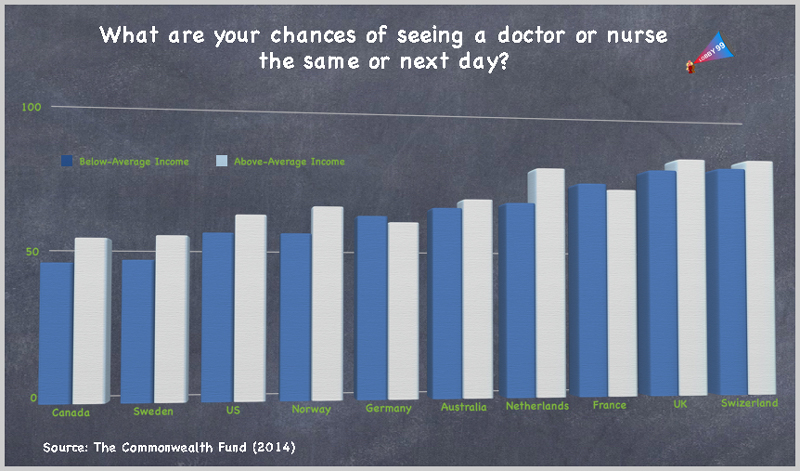
The U.S. already is among the worst countries in the easy availability of health care. Yet every one of the other countries in this chart has universal health care for its citizens. In other words, a single-payer system would not necessarily increase your wait to see your doctor.
For more, read the Atlantic story.
Why would we want a system like Canada's with all of its problems?
It's smart to compare ourselves to other countries. In the previous section, we compared wait times to see a doctor.
While Canada did rank worst in that department, most countries performed better than the United States. And they all offer health care to all of their citizens - each in its own way. So why would you compare the U.S. to Canada only? There is no reason to assume the U.S. would implement a system that's identical to Canada's or any other country's.
That said, wait times are only one area for comparison. In our main page explaining the health care issue, we already pointed out that people in the United States spend almost twice as much on health care as the next highest nation, yet we rank 49th in life expectancy (Canada ranks 12th).
For details on how health care in the United States compares to some other countries, visit the More Information section of this issue discussion.
I don't want the government controlling my health care
A valid concern. Our government is supposed to work for us, rather than against us. So it's smart to look at ways the government would be involved in health care decisions...
o Determine what treatments are covered and whether you should receive them : This is exactly what insurance companies do today. There is no way around it. Otherwise your tax (or insurance premium) dollars could be wasted on untested, unneeded, and ineffective treatments. That also would open up the system to fraud possibilities.
So regardless of whether it's the government or an insurance company, these policies exist to limit waste.
There are a few differences, however, between the ways the government and insurance companies operate regarding those restrictions...
o A government is accountable to its constituents. If its policies don't work in your interests, you can help elect someone more likely to represent those interests. An insurance company offers you no such oversight.
Also keep in mind that - as the American Health Security Act is written - each state has the power to control its own health care system. That provides you with an even more direct oversight - through your governor and state legislature.
The last thing I want is more taxes
We'll just lay this out. Let's say you're a family of 4 earning $80,000 a year. How much do you pay for health care? $300 a month for insurance? $400 a year in doctor bills and medicine? Chances are you pay a whole lot more than that.
Under the American Health Security Act, you would pay $1,760 for the entire year (2.2 percent of $80,000). That's less than $150 a month. For your entire family. For everything.
But even more important. virtually every dollar of that would be used for providing health care to you and other Americans. None of it would go toward insurance company profits, as much of it does today.
So, regardless of how you might feel about the word "tax", the bottom line is it will save money and provide better health care for you and the overwhelming majority of Americans.
Private industry can do things so much more efficiently than the government
We almost decided not to even address this, because there is no basis for personal attacks on the competence and integrity of the scientists, economists, and other professionals who choose to be employed by the government rather than by private industry.
No matter where you look, you can find evidence of government programs being run in both good and bad ways. And you can find similar evidence for private industry. There is no evidence that government-run programs are inherently any less efficient than privately-run programs.
Hey, I'm rich. I want to be able to get extra premium care
You can.
Health care providers who treat Americans and are paid by their state's agency for services would be required to accept the set amount for those services as full payment. Nothing prevents you from paying a doctor or hospital of your choice for extra premium care - as long as they don't also bill the government for treating you.
This would be a monopoly - and monopolies hurt consumers
Even if a single-payer system were a monopoly, it would not be a private one that exists to make a profit. It would be a public one that exists for the benefit of the public.
That said... a single-payer system wouldn't be a monopoly anyway. Doctors would not be required to work within the system. However, if they do become part of the system, they would need to accept the rate paid by the federal government.