
Understand the big picture
 | |||
| Follow us... | |||
 |  | ||
| Published: | 2012-Jul-17 |
| Last Updated: | 2026-Sep-22 |
| Principal Writer: | Rob Dennis and Barry Shatzman |
 | Understanding The Issue |
 | The Rumor Mill |
SAVE Act
2025 (S-1383)
Voting Rights Act1965 (S-1564)
(2017) Cooper v. Harris(2015) Az Legislature v. Az Independent Redistricting Commission
(2013) Shelby County v. Holder
We gotta ask...
DID YOU JUST LEARN SOMETHING?
Is it worth a dollar?
News in FiVe is free to read, but it takes time and money to publish.
If you find what we do valuable, please help us continue with a small donation.
Even a dollar or three every so often makes a difference.
It's secure and takes only about a minute.
Thanks!
How should we decide who votes?
Voting is the core of a democracy., and elections should be above reproach. Most would agree on several features of elections needed to achieve that objective.
o They should be able to vote at a location that is safe and close to their home, at no cost to them, without undo hardships, and without revealing their vote.
o Anyone not legally eligible to vote should not be allowed to cast a vote.
o You should be assured that your vote was recorded exactly as you intended.
The country has a mixed history of achieving these objectives.
Who has been allowed to vote over time?
The right to vote used to be restricted to certain segments of the population. It is only within the past 100 years that women have been allowed to vote.
Landmark expansions on voting rights include...
| 1787 | White male property owners at least 21 years old |
| 1843 | White men at least 21 years old |
| 1870 | Men at least 21 years old (15th Amendment) |
| 1920 | Men and women at least 21 years old (19th Amendment) |
| 1971 | Men and women at least 18 years old (26th Amendment) |
Blacks in the South could not vote
African Americans were given the constitutional right to vote in 1870. Over next 30 years, 22 served in Congress. All were from southern states.
That changed around 1900 in the South. States such as Alabama, Georgia, Louisiana, Mississippi, and South Carolina concocted methods to keep blacks from voting. These methods were part of what was referred to as Jim Crow laws.
o Property ownership was made a requirement to vote.
o Poll taxes of up to $50 in today's money.
o People's names were removed from the official list of voters, so when they showed up to vote they would find they weren't registered.
o Former prisoners often were not allowed to vote. Blacks often were arrested on false charges or for minor offenses.
o Violence - including killing and burning homes of blacks (or their families) who tried to vote.
Many of these restrictions affected poor whites also. There was a remedy for some of these, however. If a person failed a literacy test or did not own property, they still would be allowed to vote if their grandfather had been allowed to vote. Though this grandfather clause applied to blacks as well as whites, virtually no black person in the South had a grandfather who had been able to vote during the slave era.
The 1965 Voting Rights Act changed much
Two major changes to voting laws led to what many consider the end of the Jim Crow era and the disenfranchisement of black voters.
In 1964, the Constitution's 24th Amendment eliminated poll taxes.
The following year, Pres. Lyndon Johnson signed the Voting Rights Act .
Under the Voting Rights Act, polling places no longer could require a test of knowledge or character before allowing a person to vote. Nor could they intimidate citizens into not voting.
Also, jurisdictions that had used such practices in the past that wanted to make changes to their election practices would need to pre-clear the changes with federal government.
The law became one of the most successful in U.S. history. Within its first year, more than a quarter of a million new black voters had been registered.
This chart shows the long-term effects on voter registration rates in affected states...
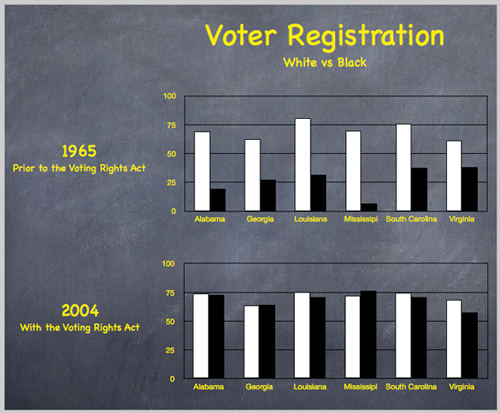
Data compiled from Congressional reports and cited in the 2013 Shelby County v Holder Supreme Court decision
Discrimination surfaces in other forms
Old discrimination tactics such as poll taxes and literacy tests have essentially been vanquished. But attempts to disenfranchise minority voters have not ended. The methods simply take on new forms...
o In 2003, a Texas county announced it would eliminate all five polling places that served a predominantly-Latino part of San Antonio. The federal government refused to pre-clear the changes - hence they did not take effect.
o In 2001, the white mayor and all-white Board of Aldermen in a Mississippi town tried to cancel an election after black citizens became a majority of registered voters. The town refused to have the election until the Department of Justice required it in 2003.
In the past 15 years, the Department of Justice (DOJ) has turned down 86 requests for election changes. But that understates the problem. Between 1999 and 2005, more than 250 changes were withdrawn or replaced by altered submissions after the Department of Justice requested more information.
Proof of citizenship will prevent citizens from registering
There have been several attempts - the most recent being the 2026 Safeguard American Voter Eligibility (SAVE) America Act - to require anyone registering to vote to provide proof of U.S. citizenship. Even those updating their existing registration would need to provide the proof.
Proof difficult for many
But approximately 1 in 10 eligible U.S. voters don't have easy access to what is known as Documentary Proof of Citizenship (DPOC) - typically their passport or birth certificate.
For starters, only about half of U.S. citizens have a passport.
For the other half, that means having a birth certificate. If you don't have a certified copy of yours, obtaining one can take weeks. And it can be an ordeal. You may need a government ID. If you don't have one, you'll need to go through various processes that include additional forms.
You'll also need to pay a fee.
Almost 4 million eligible voters (that's 2 percent) don't have a birth certificate. This is particularly true of many older Americans and Black Americans - especially in the South - who weren't born in a hospital and were not automatically issued a birth certificate.
Presenting the proof also a challenge for many
Even having easy access to the right documents still can stop some people from registering to vote, according to a study by the Brennan Center and other organizations.
The 1993 Motor Voter Act allows people to automatically update their voter registration when they register their car. And many people register to vote during registration drives at places such as schools and churches. Those ways to register could become meaningless, since most people generally don't carry around these documents.
For most, proving their citizenship will require an actual visit to an election office during business hours. For those who live in urban areas and don't own a car, registering to vote could require hours on public transportation. As well as the fare.
The situation could be worse for the 60 million voters living in rural areas. Their election office might be hundreds of miles away. Live in Alaska or Hawaii? You might need to catch a flight.
Taxpayers would pay
Once someone gets to their election office, they might find themselves waiting behind many others there for the same reason. To handle the hundreds of thousands of people across the country visiting elections offices to prove their registration in person, significantly more staff and infrastructure would be needed - paid for by taxpayers.
A 2025 report by Demos, Campaign Legal Center, and State Voices concluded that requiring documented proof of citizenship for voters can cost a state millions of dollars in staffing ,computer updates, training, and correcting errors.
States that have done this invalidated legit registrations
Some states have implemented their own DPOC laws. Federal courts have ruled them to be unconstitutional for federal elections because they conflicted with the federal Motor Voter Act (states were allowed to keep them for state offices).
A federal law requiring DPOC would not have that issue. However, the states later found that the vast majority of voters removed from the rolls - thousands of them - were in fact citizens.
In 2024, Alabama removed 3,251 registered voters for being non-citizens. At the time a lawsuit was filed, at least 2,074 of them were found to be eligible voters.
From 1999 - 2013, Kansas confirmed that 39 noncitizens had registered to vote. In 2013, the state enacted a DPOC law under then Secretary of State Kris Kobach. The law prevented more than 30,000 legitimate voters from voting.
On the other hand, there virtually no evidence that non-citizens cast votes in any federal election.
Voter ID - For some they can be nearly impossible to get
A recent barrier to voting has been state laws requiring voters to show a government-issued identification card when they vote.
Voter ID laws make it nearly impossible for approximately 10 percent of eligible voters to vote, according to a 2012 study by the Brennan Center for Justice.
There's no such thing as a free ID
Though the IDs themselves are supposed to be provided at no cost, the supporting identification required to obtain the ID - such as a birth certificate - do cost money. Married women whose names differ from that on their birth certificate also are required to provide a marriage certificate. In Wisconsin, the most expensive state to obtain both documents, the total cost ranges from $5 to $40.
Many people live far from state offices
A more imposing barrier is getting to a state office that issues the required ID. More than a million voters who don't have valid voter identification live more than 10 miles from the nearest office. About 500,000 of those do not have access to a car.
"By definition, eligible voters who need photo ID will not have a driver's license, so they cannot drive themselves to a government office," the report points out. States with the most restrictive voter ID laws also are among those that spend the least in public transportation.
It isn't just where. It's when
Someone who successfully overcomes those barriers still faces an overwhelming challenge - the state offices are open for limited and erratic hours. Many are not open on every weekday, or are open for fewer than eight hours a day.
o In Alabama, one office is open only on the third Thursday of the month. In Mississippi, an office is open only on the second Thursday.
o In downtown Wichita, Kansas, there is only one office to serve more than 160,000 voters.
Just finding out when an office is open can be a problem. In Georgia, most county offices do not make their business hours easily accessible online, and some have incorrect addresses and phone numbers listed.
"Even when contacted directly, county offices in Georgia frequently gave incorrect information about free IDs," the report states.
Click here to continue to the next section of this issue...